


MyDeskViewer is ready for testing after two years
After roughly two years of design, testing and rebuilding key parts of the project, MyDeskViewer is ready to leave the development environment and reach a wider group of testers.
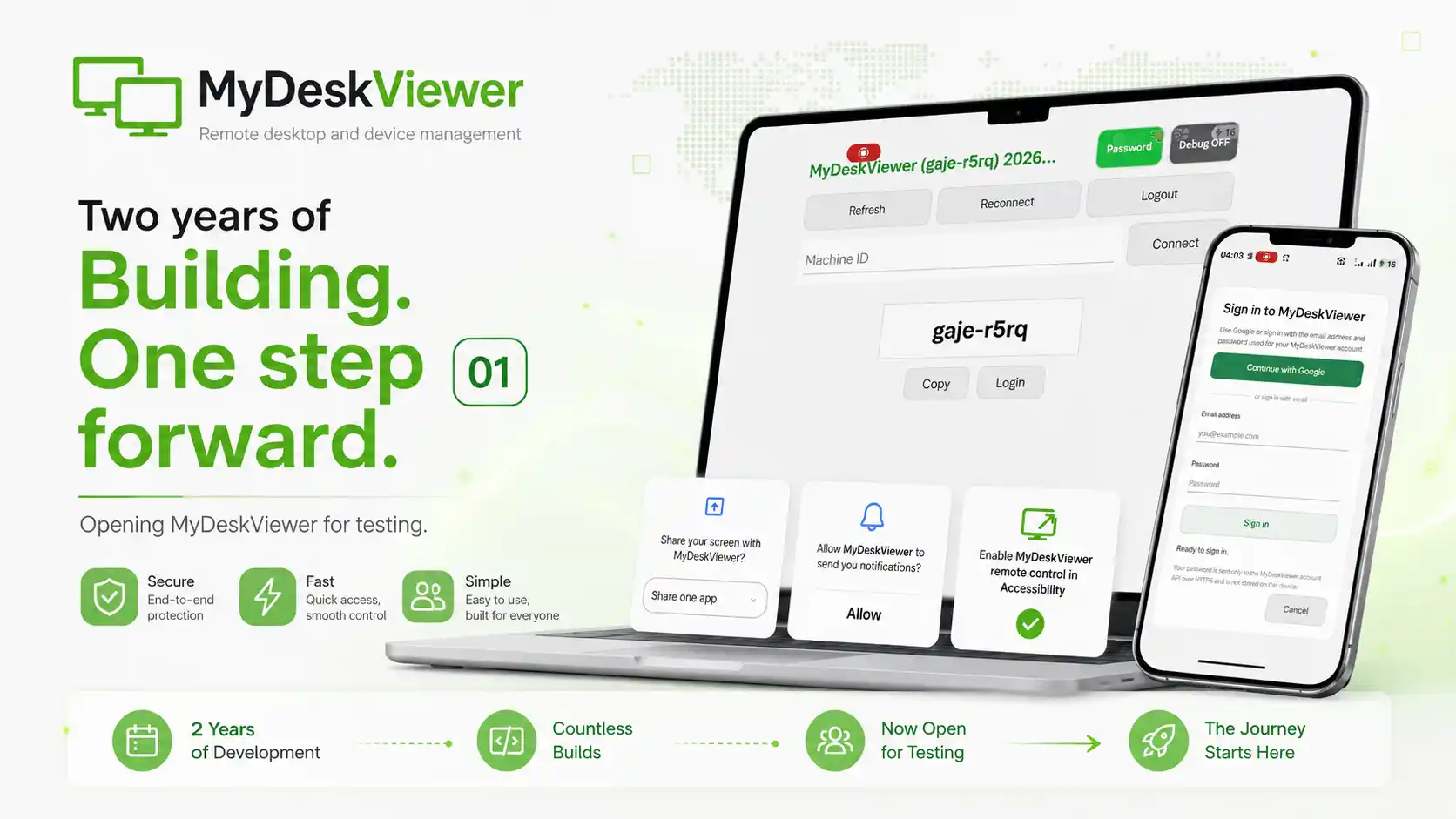
After roughly two years of work on MyDeskViewer, we have reached the point where the project can finally be shown to a wider group of users. For most of that time, the application was developed primarily as a technical tool: it had to work, solve real problems and make it possible to reach a remote device when access was actually needed.
The earliest versions had very little in common with a product that could comfortably be handed to other people. There were prototypes, connection tests, changes to device identification, interface rebuilds and many cases where a feature that worked perfectly on one machine behaved differently on another. Over time, more and more effort moved away from adding features and toward stability, error handling, reconnection and predictable application behavior.
Another major step was moving beyond a single system and a single usage scenario. MyDeskViewer gradually started to cover more devices and more ways of working with a remote session. Mobile versions added another layer of complexity: system permissions, screen sharing and remote control all need to remain simple from the user's point of view while still respecting the security boundaries of the operating system.
We will not publish details of the internal implementation or the low-level mechanisms used by the project. Those parts remain confidential. On this blog we want to focus on what users actually experience: connections, sign-in, devices, reliability, mobile versions and the product decisions that shaped the project.
At that stage, wider public testing was still essential because different computers, networks, phones and real-world configurations could not be reproduced entirely in a development environment.
After two years, MyDeskViewer was mature enough to begin its next phase: wider public use and continued development informed by real-world feedback.